If you have been browsing listings for real estate in Vienna Austria, you have probably noticed something odd. The prices look almost gentle compared to London, Paris, or Zurich, yet the apartments themselves are enormous, ceilings are 3.4 meters high, and half the buildings have frescoes in the stairwell. That gap between price and quality is exactly why international buyers keep showing up here. I have spent the last few years following this market closely, and it rewards people who understand its quirks. It punishes people who treat it like any other capital city.
What does property in Vienna cost right now?
Let me give you the honest numbers. As of early 2025, the average price for a well-located apartment in Vienna sits around €6,500 per square meter. In the prime inner districts, you are looking at €9,000 to €12,000 per m², and true trophy properties in the Innere Stadt or on the Ringstrasse can pass €15,000 per m². A three-room Altbau flat in district 4 or 7 with original stucco and herringbone parquet typically trades between €700,000 and €1.1 million.
Here is the context that matters: prices fell roughly 8 to 10 percent from their 2022 peak and have been flat-to-slowly-recovering since. That means you are buying after a correction, not at the top. The interest rate shock hit Austrian buyers hard, many of whom had variable-rate mortgages, and the market is still digesting that. Foreign cash buyers have an unusual window here.
One thing I always tell people: Vienna measur
 es living space generously. The quoted square meters usually include cellar storage and a share of communal areas, so a 90 m² Viennese flat often feels smaller than a 90 m² flat in Berlin. Budget with that in mind.
Which districts should luxury buyers focus on?
Vienna has 23 districts, and honestly, only about eight of them matter for a luxury purchase. The numbering system helps: districts 1 through 9 form the inner ring around the center, and that is where the old money lives.
- District 1 (Innere Stadt): the historic core. Palais apartments, cobblestones,€12,000 to €16,000 per m². Slightly dead on weekends, gloriously quiet.
- District 3 (Landstrasse): my personal sleeper pick. Consular buildings, embassies, the Belvedere gardens, and prices around €8,500 per m². Still undervalued relative to its neighbors.
- District 7 (Neubau): design shops, galleries, great restaurants, a younger crowd. Around €9,000 per m².
- District 13 (Hietzing): villas near Schoenbrunn, gardens, top schools. This is where families with €3 million plus tend to end up.
- District 19 (Doebling): the classic villa belt on the Vienna Woods hills. Heuriger wine taverns, vineyards technically inside the city. Yes, really.
Districts 2 and 9 are worth watching too. The area around the new University of Economics campus in district 2 has seen serious modern development, and if you want a penthouse with a Danube view rather than a stucco ceiling, that is where you look.
Old building or new build?
This question splits Viennese buyers into two camps who barely speak to each other. I exaggerate, but only slightly.
The Altbau (pre-1918 apartment buildings) is the emotional purchase. Ceiling heights of 3.2 to 4 meters, double-winged doors, ceramic stoves that nobody uses anymore, floor plans with a formal layout. The catch is condition. Many of these flats have never been renovated and need €1,000 to €2,500 per m² of work, plus months of dealing with building regulations, since facades and stairwells in protected zones are landmarked.
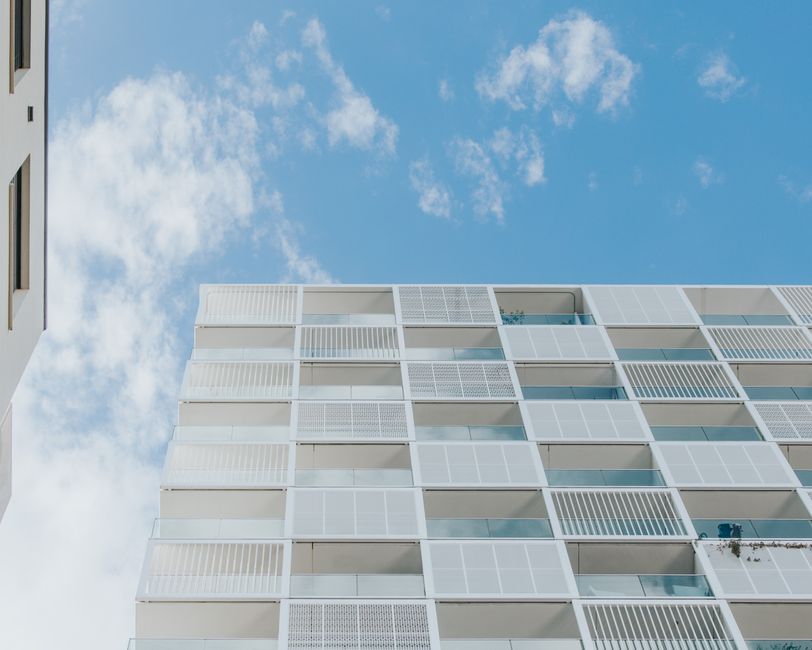
The new build is the rational purchase. Better insulation (energy class A instead of a leaky 1910 building), elevators, underground parking, floor-to-ceiling glass. Prices run maybe 15 percent higher per m², and the rooms are smaller. But you are not signing up for a construction project that lasts two years.
My take, for what it is worth: buy the Altbau if you are buying a home you plan to keep for a decade, buy new build if this is partly an investment you might exit in five years. New builds hold their value with less drama.
What are the actual costs of buying?
Austria is refreshingly transparent here, but the total purchase costs surprise people. They add up to roughly 6 to 7 percent on top of the purchase price:
| Cost item | Rate |
|---|---|
| Property transfer tax (Grunderwerbsteuer) | 3.5% (6% in Vienna above €100,000) |
| Land registry fee | 1.1% |
| Notary or lawyer fees | roughly 1 to 1.5% |
| Real estate agent commission | 3% plus 20% VAT (often split) |
Note the Vienna quirk: the capital charges 6 percent transfer tax on the amount above €100,000, not the flat 3.5 percent used in most provinces. On a €1.5 million purchase that difference is real money, around €38,000 in transfer tax alone. Also expect the agent to ask you, the buyer, to pay commission. In many countries the seller pays. Not here, usually.
Ongoing costs are modest. Annual property tax on a €1 million flat is often under €500, which sounds like a typo to anyone from New Jersey. Building maintenance (the famous Austrians-love-their-Hausverwaltung system) runs €2 to €4 per m² per month.
Can foreigners buy, and is it difficult?
EU citizens face no restrictions at all. You buy, you own it, done. Non-EU buyers need approval from the municipal authority, which sounds scary and in practice is a formality in most cases, taking six to twelve weeks. If you buy through an EU-based company you control, the approval is often not even required. Many international buyers structure purchases this way, and any local notary will walk you through it in one meeting.
Two practical warnings from me. First, financing as a non-resident is possible but rates are worse than what Austrians get, typically 1 to 1.5 percentage points above domestic mortgage pricing, and banks want 30 to 40 percent down. Second, hire a German-speaking lawyer before you sign anything. Contracts are signed in front of a notary in German, and the pre-contract stage (where the real negotiation happens) happens fast.
Should you rent it out?
Vienna has strict rules on short-term rentals like Airbnb, effectively banned in most residential buildings unless the flat is your registered primary residence and you only sublet part of it. Long-term rental is far friendlier: gross yields in central districts run 3 to 3.5 percent, which is not spectacular but is stable. Vienna consistently ranks at or near the top of global quality-of-life indexes, and that is reflected in a rental market where demand never really dries up. The city’s population grows by around 10,000 people a year and housing construction has slowed, so the medium-term supply picture is on your side.
What does a million euros actually buy?
Concrete example, because abstract price-per-square-meter talk only goes so far. In 2025, €1 million in district 1 gets you roughly 70 to 80 m² in a well-kept Altbau, a proper two-bedroom but not a palatial one. The same money in district 3 buys 110 to 120 m² with a balcony. Push out to district 10 or 21 and you are looking at a duplex with a terrace in a new build, though I would question why you are buying in Vienna at all if that is the goal. The whole point of this city is the center.
Compare that to Monaco at €50,000 per m² or central Paris around €12,000 to €13,000 per m², and Vienna starts to look like the last reasonably priced imperial capital in Western Europe. I genuinely believe that, and I am not alone: German, Swiss, and increasingly Middle Eastern buyers have been the most active foreign groups in the market over the past two years.
The bottom line
Vienna rewards patience and punishes impulse. Pick your district first, because the difference between district 3 and district 1 is bigger than any negotiation you will ever do on price. Budget 7 percent for transaction costs. Get a German-speaking lawyer early, and do not fall in love with an unrenovated Altbau unless you have €150,000 of renovation budget and a high tolerance for dust. Buy after a correction, in a city that keeps winning liveability rankings, with transaction costs you can calculate on a napkin. That is not a bad combination anywhere in the world, and right now it is sitting in the middle of Europe with the doors open.